That combination is exactly why hot tub wiring is governed by some of the strictest rules in the electrical code. A standard outlet won't do it. An extension cord is dangerous. And a circuit that isn't properly grounded, bonded, and GFCI-protected isn't just a code violation — it's a real shock hazard.
Swamp Rabbit Electric installs dedicated, code-compliant hot tub and jacuzzi circuits for homeowners throughout Greenville, SC and the Upstate. With over two decades of hands-on experience and licensing from some of the toughest jurisdictions in the country, we make sure your spa is powered safely, passes inspection, and is ready the day it's delivered.
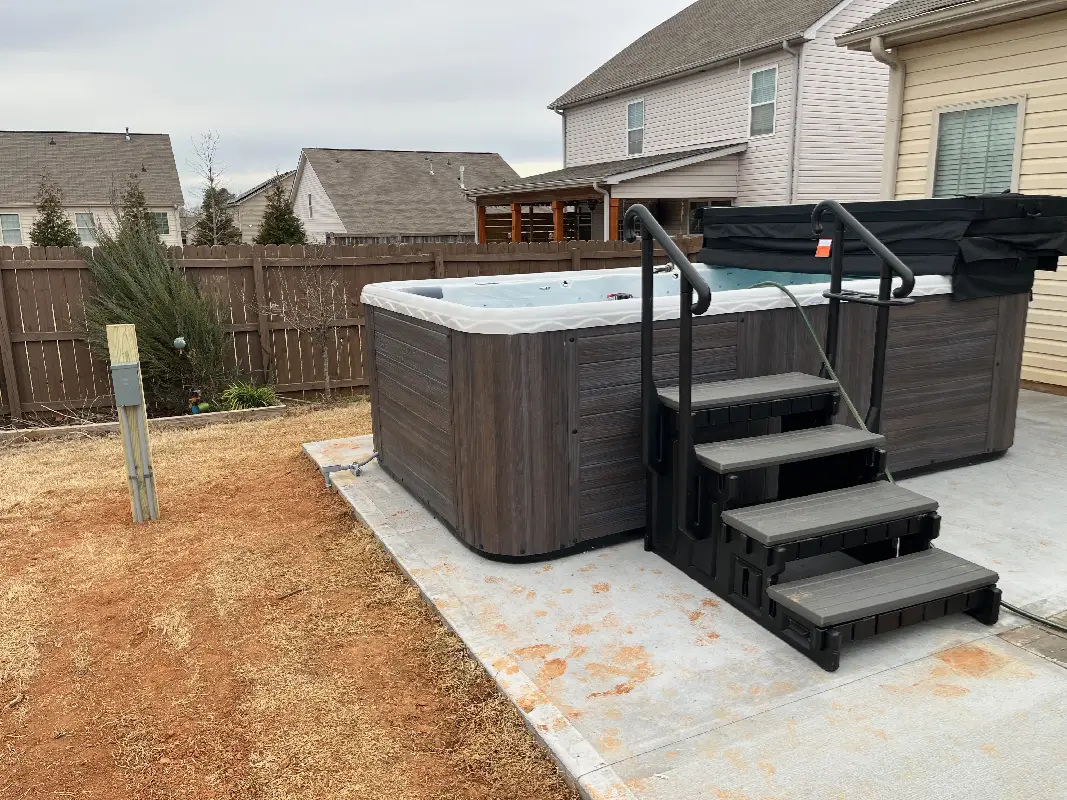
Most hot tubs can't simply plug into an existing outlet. Here's what proper spa wiring actually requires — and why it matters:
Most full-size hot tubs run on a dedicated 240-volt, 50-amp circuit (some models need 40 or 60 amps). That circuit can't be shared with anything else in the house.
Code requires the spa circuit to be protected by a GFCI. If the system ever senses current leaking where it shouldn't, it shuts power off in a fraction of a second — the single most important safety feature on the whole hookup.
A maintenance disconnect must be installed within sight of the tub and at least five feet away from the water. It lets anyone cut power instantly in an emergency and keeps service techs safe.
The metal parts around your spa have to be bonded together so they all sit at the same electrical potential. This is one of the most commonly skipped steps by unlicensed installers — and one of the most dangerous to miss.
Conduit, connectors, and the disconnect all have to be weather-rated for a wet, outdoor location. Indoor-grade materials fail fast and create hazards.
Undersized wire overheats. We size the conductors to your spa's exact amperage and the distance from your panel — no guesswork.
If your hot tub is already installed and running on the wrong setup, it's worth a call before it becomes a problem.
Wiring a hot tub the right way is more than running a line to the backyard. Here's what the process looks like when Swamp Rabbit Electric handles the job:
We review your spa's electrical requirements (voltage and amperage from the manufacturer's spec sheet), check your existing panel for available capacity, and plan the best route from the panel to the tub.
We determine the right wire size, conduit run, and the location for your GFCI-protected disconnect — placed within sight of the spa and the required distance from the water.
Hot tub circuits require a permit in Greenville County and must meet NEC Article 680, the section of code written specifically for pools, spas, and hot tubs. We handle the permit and coordinate the inspection.
Daniel installs the dedicated circuit, the weatherproof disconnect, and the equipotential bonding, then connect everything to your spa's control pack. Every connection is verified before we leave.
A county electrical inspector confirms the work meets code. You get a safe, fully compliant hookup — and the documentation to prove it.
Not every spa is wired the same way, and knowing which type you have tells you what the job involves.
The cost of wiring a hot tub depends on a few key factors: the distance from your electrical panel to the spa, whether your existing panel has room for the new circuit, the amperage your spa requires, and whether any trenching or a dedicated spa subpanel is needed.
For a typical residential hot tub hookup in Greenville, most homeowners can expect to invest between $800 and $2,500, depending on the scope of work. A spa located close to the panel with available capacity will fall on the lower end. Longer runs, trenching across a yard, a panel that's already full, or a tub that requires its own subpanel will push the cost higher.
The biggest cost drivers are distance and access. A hot tub fifteen feet from the panel is a very different job than one at the far corner of the backyard.
Added a breaker box for my swim spa. Great attention to detail, and very knowledgeable. I love this company, Thank you so much for everything.
Danny did a great job wiring up my hot tub. I would highly recommend him!
"Daniel responded quickly, arrived on time, and did a thorough and meticulous job. I will be hiring Swamp Rabbit Electric again to meet any electrical needs I have in the future."
We proudly serve homeowners and businesses in:
Whether you're searching for an electrician near you, emergency electrical repair, panel upgrades, EV charger installation, or lighting services in Greenville—you're in the right place.
Most full-size hot tubs require a dedicated 240-volt, 50-amp GFCI-protected circuit, though some models call for 40 or 60 amps. Smaller plug-and-play spas run on a 120-volt, 15–20 amp GFCI outlet. Always check your spa's spec sheet — we'll confirm the exact requirement before we wire anything.
Yes. Hot tub and spa circuits require an electrical permit in Greenville County, and the work has to pass inspection under NEC Article 680. We handle the entire permitting process and coordinate the inspection for you.
Code requires a maintenance disconnect to be installed within sight of the spa and at least five feet from the water. This lets anyone shut off power instantly in an emergency while keeping the switch a safe distance from the tub.
Absolutely. Whether your spa was just delivered or it's been sitting unpowered in the backyard, we can run the dedicated circuit, install the disconnect and bonding, and connect it to the spa's control pack. If a previous hookup was done incorrectly, we can correct it and bring it up to code.
Yes — it's required by code and it's the most important safety feature on the entire installation. Because a hot tub combines electricity, water, and people, GFCI protection shuts power off the instant it detects a fault, preventing serious shock.
A straightforward hookup is often completed in a single day. Jobs that require trenching across a yard, a panel upgrade to free up capacity, or a dedicated spa subpanel may take longer. We'll give you a clear timeline upfront.