A home Level 2 charger lets you plug in when you get home and wake up to a full battery every morning — no detours, no waiting, no per-kWh markup.
Swamp Rabbit Electric installs EV chargers for homeowners across Greenville, SC and the surrounding Upstate communities. With over 20 years of electrical experience and hands-on training from top journeymen in New York City, we handle every part of the installation — from evaluating your panel capacity to running the dedicated 240-volt circuit to mounting and testing your charger.
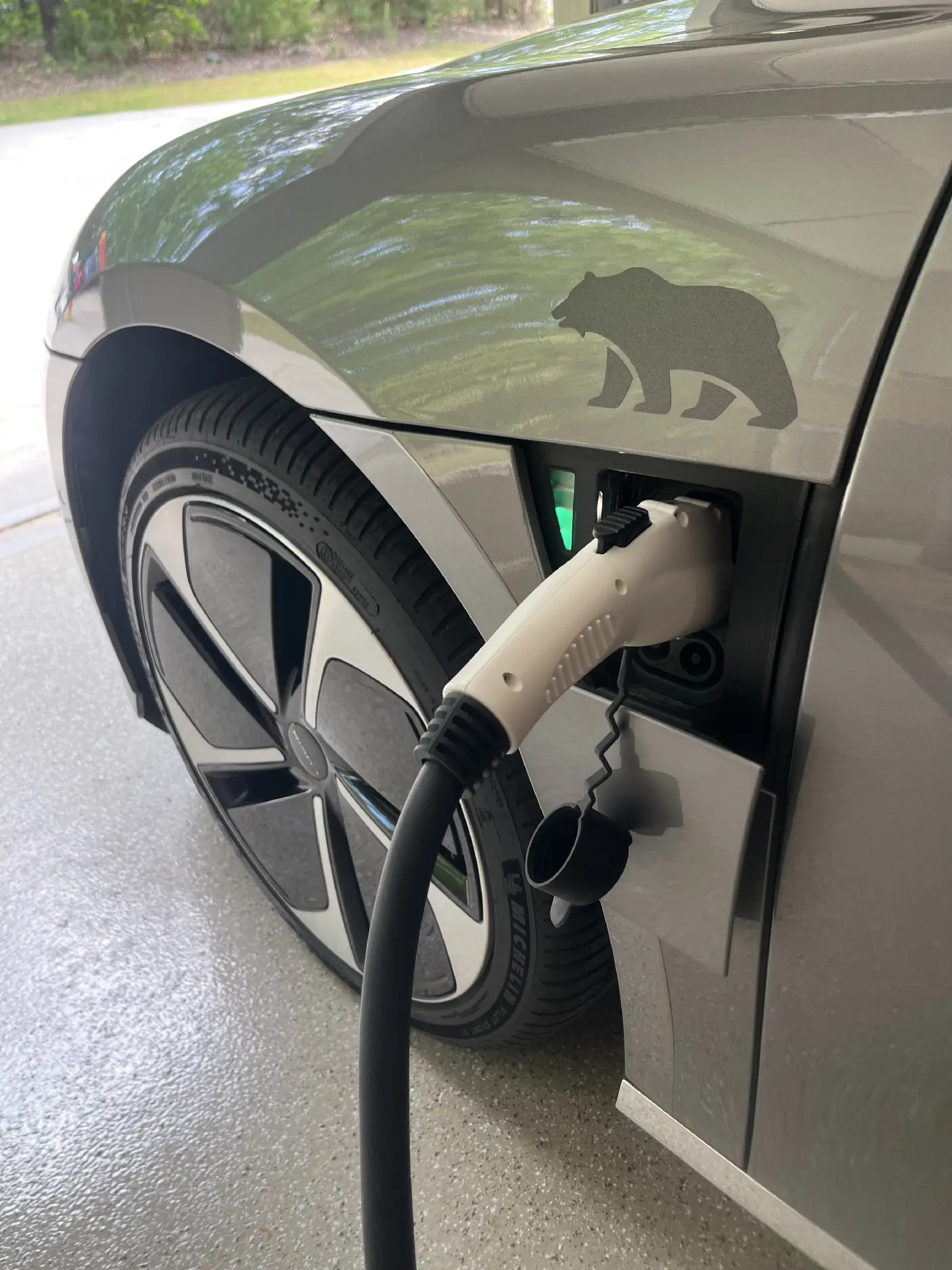
Every EV comes with a Level 1 charger that plugs into a standard 120-volt household outlet. It works, but it's slow — adding roughly 3 to 5 miles of range per hour. If you drive 40 miles a day, you're looking at 8 to 12 hours just to recover that range. For most EV owners, Level 1 charging quickly becomes impractical.
A Level 2 charger runs on a 240-volt dedicated circuit — the same type of circuit your dryer or oven uses — and delivers 20 to 40 miles of range per hour depending on the charger's amperage and your vehicle. That means a full overnight charge, every night, regardless of how much you drove that day.
We install Level 2 EV chargers from all major manufacturers, including:
The most popular home charger for Tesla owners. Hardwired installation with up to 48 amps and a built-in NACS connector. We also install the Universal Wall Connector for households with mixed EV brands.
A versatile, Wi-Fi-enabled charger that works with all J1772 and NACS-compatible vehicles. Adjustable amperage from 16 to 50 amps.
A durable, weather-rated charger popular for outdoor and garage installations. Simple, reliable, and built to handle South Carolina's heat and humidity.
We install any UL-listed Level 2 charger. If you've already purchased your unit, we'll install it. If you haven't picked one yet, we can help you choose the right charger.
Whether you drive a Tesla, Ford F-150 Lightning, Chevy Equinox EV, Rivian, BMW, Hyundai, Kia, or any other electric vehicle, we've got you covered.
Installing an EV charger isn't just mounting a box on the wall — it's adding a high-draw appliance to your home's electrical system. Here's how we handle it:
Before anything else, we evaluate your existing electrical panel to make sure it has the capacity to support a Level 2 charger. Most Level 2 chargers draw 40 to 60 amps, which is a significant load. If your panel is already near capacity, we'll discuss your options — which may include a panel upgrade or a load management solution.
We plan the wiring route from your panel to the charger location, whether that's inside your garage, on an exterior wall, or in a detached structure. Shorter runs keep costs down, but we handle longer runs too — including outdoor conduit and trenching when needed.
We install a new double-pole breaker, run properly sized wiring (typically 6-AWG or 8-AWG copper depending on amperage), and either hardwire the charger directly or install a NEMA 14-50 outlet for plug-in units. Every connection is made with copper wire and runs through conduit where required.
We mount the charger at the correct height, connect it to the circuit, and test the full system — charger communication, voltage output, and GFCI protection — before we leave. You'll plug in your vehicle with us on-site to confirm everything works.
EV charger installations in Greenville County require an electrical permit. We handle the permit application and coordinate the final inspection so everything is documented and code-compliant. This step also matters if you plan to claim the federal tax credit — unpermitted work can disqualify you.
The cost of a home EV charger installation in Greenville depends on your electrical setup, not the charger brand. The main variables are your panel's available capacity, the distance from the panel to the charger location, and whether the install is indoor or outdoor.
For a straightforward installation — panel has capacity, charger goes in an attached garage near the panel — most homeowners in the Greenville area can expect to pay between $500 and $1,500 for the electrical work, not including the charger unit itself (typically $300 to $700).
If your panel needs an upgrade or the wiring route is long or complex (detached garage, exterior wall, underground conduit), the total can range from $1,500 to $4,000+ depending on the scope.
"I recently hired Danny to change out several light fixtures and install a NEMA 14-50 outlet for EV charging, and I couldn't be happier with the results. He was professional, punctual, and clearly knew what he was were doing. The lighting looks perfect, and the outlet was installed cleanly and works flawlessly. Everything was done safely and up to code, and he even cleaned up after the job. Highly recommend for any electrical work—reliable and skilled!"
"Daniel installed an EV Charger and Fan, Outstanding work, excellent price, and left the job as clean as he found it. I would definitely use again"
"Daniel responded quickly, arrived on time, and did a thorough and meticulous job. I will be hiring Swamp Rabbit Electric again to meet any electrical needs I have in the future."
We proudly serve homeowners and businesses in:
Whether you're searching for an electrician near you, emergency electrical repair, panel upgrades, EV charger installation, or lighting services in Greenville—you're in the right place.
Most installations are completed in two to four hours. If we need to upgrade your panel or run a long wiring route, it may take longer — but the majority of jobs are finished in a single visit
Not always. If your panel has available capacity and open breaker slots, we can add the dedicated circuit without upgrading. If your panel is full or already near its amp limit, a panel upgrade or subpanel may be necessary. We determine this during the initial assessment.
Yes. We run wiring through outdoor-rated conduit or underground conduit to reach detached garages, carports, and other structures. These installations cost more than a standard garage install due to the longer wiring route, but we handle them routinely.
Both work well. Hardwired installations are cleaner, eliminate the outlet as a potential failure point, and are required for chargers over 40 amps. Plug-in setups (using a NEMA 14-50 outlet) offer flexibility if you want to swap chargers later or take the unit with you when you move. We'll recommend the best option based on your charger and situation.
Yes, but it depends on your panel's capacity. If you have a 200-amp panel with room, we can install two dedicated circuits. If capacity is tight, we can discuss load management options or a panel upgrade. More households are moving to two EVs, and we plan installations with future expansion in mind.
We install any UL-listed Level 2 charger — Tesla Wall Connector, ChargePoint, Grizzl-E, Wallbox, JuiceBox, Emporia, and others. You can purchase your own charger or ask us for a recommendation based on your vehicle and needs.